The Luxury Slowdown Is Real as Gucci Revenue Falls While Hermès Continues Growing
The global luxury fashion industry is entering a noticeably different phase in 2026, and the latest earnings reports from two of the world’s biggest luxury houses reveal just how sharply the market is beginning to divide.
Kering, the French luxury conglomerate behind Gucci, Saint Laurent, Balenciaga and Bottega Veneta, reported weaker-than-expected first-quarter results, driven primarily by Gucci’s ongoing slowdown.
Meanwhile, Hermès — long considered one of the most exclusive brands in luxury fashion — once again demonstrated remarkable resilience despite broader economic uncertainty affecting global consumer spending.
Together, the numbers highlight a growing reality inside luxury fashion: not every luxury brand is experiencing the slowdown in the same way.
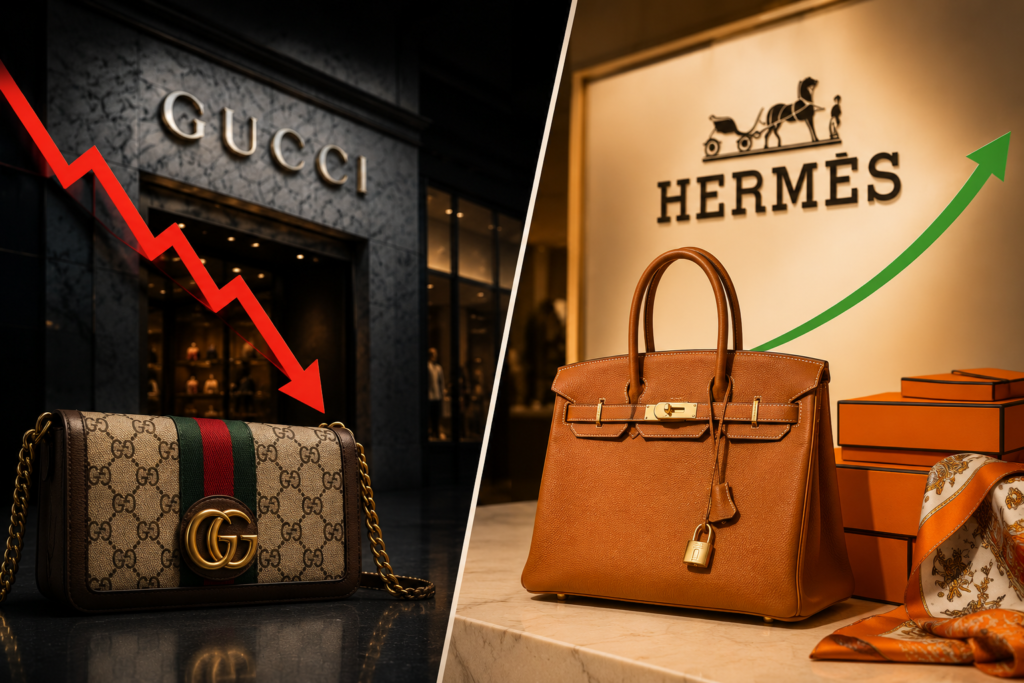
Gucci Revenue Falls 14.3% in Q1 2026
Kering reported first-quarter 2026 revenues of approximately €3.57 billion, representing a year-on-year decline of 6.2%.
The company’s biggest challenge remains Gucci, whose revenue dropped sharply by 14.3% to €1.35 billion during the quarter.
The Italian luxury house has spent the past year attempting to reposition its identity under creative director Sabato De Sarno following years of rapid growth during previous creative eras.
However, analysts say the transition has proven difficult as global luxury demand softens, particularly in China and Western Europe — two of Gucci’s most important consumer markets.
Luxury consumers have become increasingly selective in 2026, with many prioritizing timeless exclusivity and craftsmanship over trend-driven purchases.
Industry observers also note that Gucci’s broader accessibility over the past decade may now be working against the brand as the luxury market contracts and consumers shift toward ultra-premium positioning.
Hermès Continues Outperforming the Luxury Sector
In contrast to Gucci’s struggles, Hermès posted another quarter of steady growth.
The French luxury house reported approximately €4.1 billion in Q1 sales, representing a 5.6% increase year over year.
Although the figure came slightly below analyst forecasts, Hermès continues to outperform nearly every major competitor in global luxury fashion.
The company’s long-standing strategy of controlled production, extreme scarcity and uncompromising craftsmanship appears to be protecting it from many of the pressures currently affecting the wider sector.
Products such as the Birkin and Kelly bags remain among the most difficult luxury items in the world to obtain, with waiting lists that can extend for years.
Unlike brands pursuing aggressive expansion strategies, Hermès has historically focused on maintaining exclusivity rather than maximizing short-term volume growth.
That positioning is increasingly proving valuable in a slowing global economy.
Middle East Tensions Add Pressure to Luxury Markets
Hermès also acknowledged that geopolitical instability in the Middle East has begun affecting luxury demand and tourism patterns across the region.
Cities such as Dubai, Abu Dhabi, Doha and Riyadh have become some of the fastest-growing luxury markets globally over the past several years, driven by rising wealth, tourism expansion and growing consumer demand for ultra-premium fashion.
However, continued uncertainty linked to the Iran conflict and broader regional instability has created concerns around tourism flows and consumer confidence.
Luxury brands that had increasingly relied on Gulf markets for growth are now facing additional pressure at a time when demand in Europe remains sluggish and China’s recovery continues to progress slowly.
Analysts Say 2026 Is a Year of Stabilisation for Luxury
Major financial institutions and market analysts are increasingly describing 2026 as a year of stabilisation rather than strong recovery for the global luxury industry.
BNP Paribas forecasts roughly 6% organic growth across the luxury sector this year, supported mainly by the United States and a gradual improvement in Chinese consumer demand.
Europe, however, is expected to remain comparatively weak throughout much of the year.
Deloitte’s latest luxury industry analysis also suggests that fashion houses are becoming more focused on protecting profitability, tightening retail distribution and strengthening relationships with high-value clients rather than aggressively pursuing sales volume.
The shift signals a broader transformation inside luxury fashion, where long-term brand equity is becoming more important than rapid expansion.
What the Gucci and Hermès Divide Says About Luxury in 2026
The widening gap between Gucci and Hermès ultimately reflects two very different interpretations of luxury.
Hermès has maintained an identity built almost entirely around scarcity, craftsmanship and exclusivity. Its products remain intentionally difficult to access, reinforcing their desirability even during economic slowdowns.
Gucci, by contrast, spent years operating as a more widely accessible luxury brand with broader cultural reach and faster product cycles.
In today’s market environment, consumers appear increasingly drawn toward brands with clearer positioning and stronger perceptions of rarity.
As the luxury fashion slowdown continues through 2026, the companies most likely to remain resilient may be those capable of preserving exclusivity while maintaining deep emotional connections with high-spending clients.