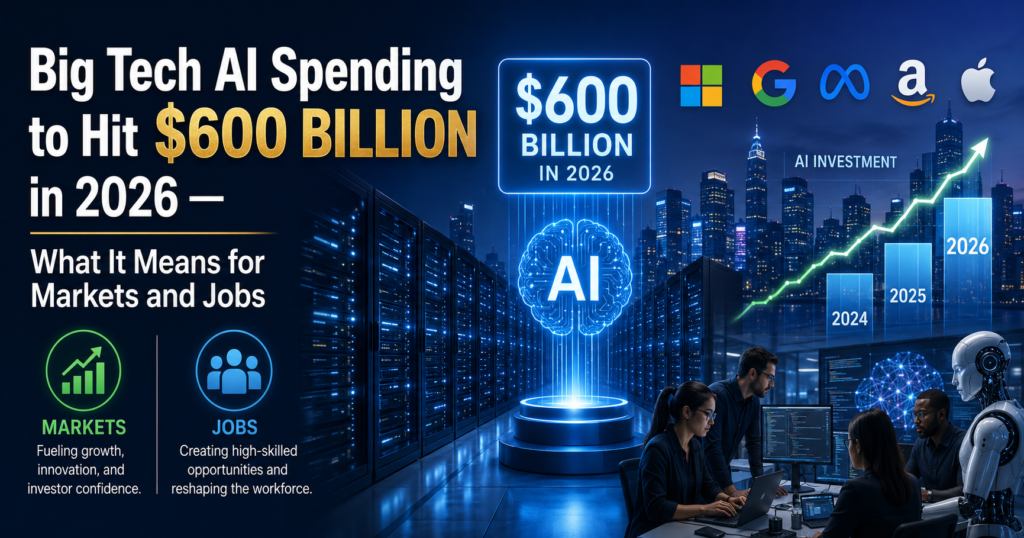
Four of the world’s most valuable technology companies — Amazon, Alphabet, Microsoft, and Meta — are collectively guiding toward approximately $600 billion in capital expenditure for 2026, the vast majority directed at artificial intelligence infrastructure. The number is staggering in its scale and its implications extend far beyond Silicon Valley, touching energy markets, semiconductor supply chains, commercial real estate, and the global labour market. ## Breaking Down the $600 Billion Each of the four mega-cap technology companies has individually guided toward record capital spending in 2026. Microsoft has committed to building AI data centres across every continent. Amazon’s AWS division is racing to expand capacity to meet enterprise demand that is outpacing its ability to build. Alphabet is deploying its custom Tensor Processing Unit chips at unprecedented scale. Meta, having pivoted its entire infrastructure strategy toward AI, is spending aggressively to close the gap with OpenAI and Anthropic. The combined figure represents the single largest coordinated private sector infrastructure build in human history — larger than the interstate highway system, larger than the space race, and arriving in a compressed multi-year window. ## Energy Is the Constraint The single biggest bottleneck for AI expansion is not chips, not talent, and not capital — it is electricity. AI data centres are extraordinarily power-intensive. The IEA has warned that data centre electricity demand could double by 2028, straining grids across the United States, Europe, and Asia. This is creating significant investment opportunities in power generation, grid infrastructure, nuclear energy, and energy storage. It is also creating political tensions in communities where large data centres are being built, as locals raise concerns about water usage, noise, and the prioritisation of AI compute over residential electricity needs. ## The Semiconductor Supply Chain Races to Keep Up NVIDIA remains the dominant supplier of AI training chips, with its H100 and upcoming Blackwell GPU architectures in extraordinarily high demand. TSMC, the Taiwanese semiconductor manufacturer that produces chips for Apple, NVIDIA, and AMD, is operating at full capacity and building new fabrication plants in Arizona and Japan to reduce geopolitical concentration risk. The AI spending surge has made semiconductor supply chain security a top priority for governments in the US, EU, and Asia — accelerating industrial policy investments that would have been politically unthinkable five years ago. ## What This Means for Workers The $600 billion spending wave is simultaneously creating jobs and threatening them. Hundreds of thousands of construction, engineering, and technical roles are being created to build AI infrastructure. At the same time, AI systems are beginning to automate knowledge work at a pace that is measurable in productivity statistics. McKinsey’s latest global AI impact assessment estimates that between 75 million and 375 million workers globally may need to change occupational categories by 2030 as AI automates portions of their current roles. The disruption is not uniform — workers in advanced economies with strong educational infrastructure are better positioned to adapt than those in developing markets. ## Bitcoin and Crypto Watch Big Tech Closely Bitcoin’s correlation with the Nasdaq 100 has climbed to 0.52, hitting 0.75 in January 2026. When big tech moves, crypto follows. Strong AI capex guidance from these four companies could trigger significant Bitcoin volatility — bullish if markets interpret the spending as a signal of broad economic strength, bearish if the capital intensity raises concerns about margin compression and equity valuations. The $600 billion AI spending wave is the defining economic story of 2026. Its reverberations will be felt across every sector, every market, and every workforce on the planet.
Big Tech AI Spending to Hit $600 Billion in 2026 — What It Means for Markets and Jobs
Related Stories