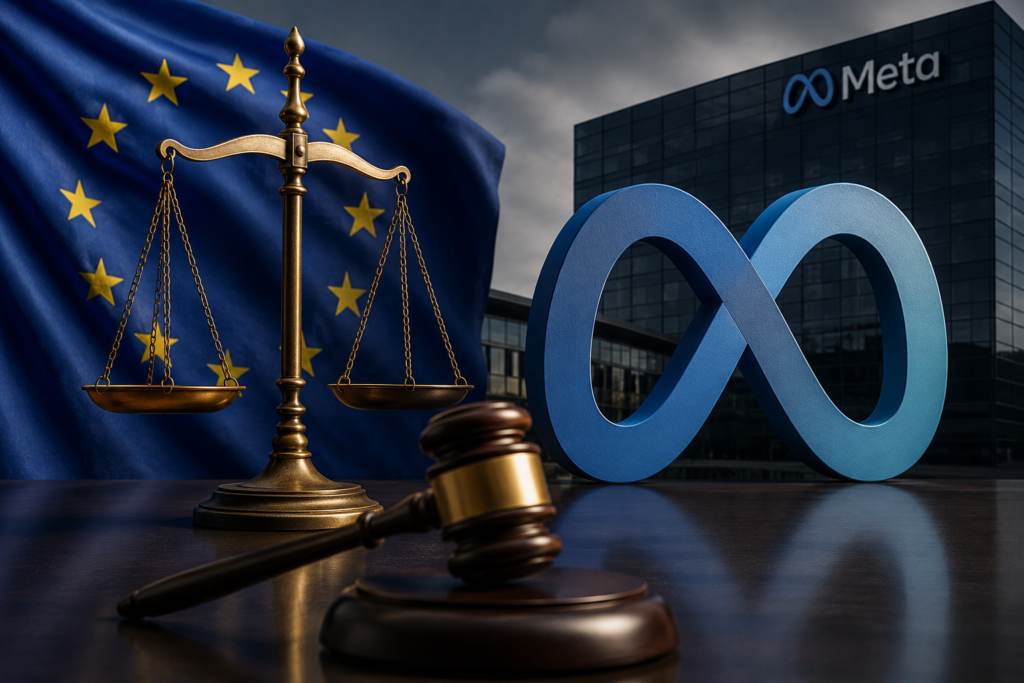
The European Union’s campaign to bring the world’s largest technology platforms under regulatory control has entered its most consequential phase yet in 2026 — and Meta, the parent company of Facebook and Instagram, finds itself at the centre of a regulatory storm that could permanently reshape how political advertising works across the entire democratic world.
What began as a series of preliminary investigations has rapidly escalated into enforcement proceedings on multiple fronts simultaneously. The stakes could not be higher. Billions of euros in potential fines, fundamental changes to how Meta’s algorithms operate, and the future of political communication across 27 EU member states are all in play.
The Digital Services Act — What It Actually Requires
To understand why this confrontation matters far beyond Europe’s borders, it is essential to understand exactly what the EU’s Digital Services Act demands of companies like Meta.
The DSA, which entered full force in early 2024, represents the most ambitious attempt by any government anywhere in the world to regulate large online platforms. It classifies Meta’s Facebook and Instagram as Very Large Online Platforms due to their combined European user base of over 400 million people — a designation that subjects them to the strictest tier of obligations in the entire regulatory framework.
Under the DSA, Meta must label every political and issue-based advertisement clearly and disclose who paid for it and how much they spent. It must explain in accessible language how its recommendation algorithms decide what content to show each user. It must conduct annual risk assessments examining whether its platforms are being exploited to spread disinformation, interfere with elections or amplify harmful content. It must submit to independent audits and provide data access to vetted academic researchers and to regulators themselves.
The financial consequences of non-compliance are extraordinary. Fines of up to six percent of global annual turnover are possible — applied to Meta’s 2025 revenues of approximately $165 billion, that represents a potential penalty of close to $10 billion.
How Meta Responded — By Stopping Political Ads Entirely
The EU also adopted a dedicated Regulation on the Transparency and Targeting of Political Advertising in March 2024, which came into full force in autumn 2025. This regulation requires every political advertisement to carry a clear label and a transparency notice disclosing the sponsor, the purpose and the amount spent — applying uniformly across all 27 member states.
Meta’s response stunned regulators and politicians alike. Rather than comply with the new transparency requirements, Meta halted all political advertising across its European platforms entirely, publicly describing the rules as unworkable. The decision immediately cut off political parties, campaign organisations, civil society groups and democratic advocacy organisations from the EU’s most powerful digital advertising infrastructure at a moment when multiple European countries were preparing for national elections.
The move was condemned by European politicians across the political spectrum and by digital rights organisations. It also exposed a deeply uncomfortable truth about the relationship between democratic institutions and the platforms that have become essential infrastructure for political communication — that those platforms can, when regulation becomes inconvenient, simply withdraw from democratic participation entirely.
The Digital Markets Act — A Second Front
While the DSA battle was escalating, Meta was simultaneously fighting a second major regulatory confrontation under the EU’s Digital Markets Act — a parallel piece of legislation specifically targeting the market power of dominant digital platforms.
The European Commission found Meta in breach of the Digital Markets Act in April 2025, issuing a formal non-compliance decision related to how Meta was handling user choice in advertising. The Commission ruled that Meta was not giving European users a genuine, fair choice between personalised and non-personalised advertising experiences.
Meta subsequently committed to offering EU users a real choice — either consenting to full data sharing for completely personalised advertising, or opting for reduced data sharing with more limited personalisation. These new options were rolled out to European users in January 2026.
The financial implications for Meta are significant. Early data suggests that between 30 and 40 percent of European users presented with this choice are selecting the reduced personalisation option — a shift that directly reduces the value of Meta’s advertising inventory for European campaigns and represents a meaningful long-term revenue impact.
Consumer Groups Add Further Pressure
As if the Commission’s own enforcement actions were not enough, Meta now faces additional pressure from organised civil society across Europe.
A comprehensive field survey conducted between December 2025 and March 2026, spanning 13 European nations, identified more than 900 commercial advertisements on Meta’s platforms that allegedly violated European law by directly promoting financial scams, deceptive investment schemes and fraudulent products.
The Greek Consumer Protection Association, leading a coalition of 29 national consumer associations representing all 27 EU member states under the umbrella of the European Consumer Organisation, filed formal complaints with the Commission demanding immediate investigations into Meta, TikTok and Google. The coalition called explicitly for heavy financial penalties in the event of continued non-compliance — adding significant political momentum to regulatory proceedings that were already moving rapidly.
Meta Is Not the Only Target
It is important to understand that Meta is not the only platform facing serious consequences under the EU’s digital regulatory framework. The Commission has been applying the DSA systematically across the entire ecosystem of large platforms.
TikTok committed in December 2025 to bringing its advertising repository into full DSA compliance following preliminary Commission findings earlier that year, with implementation deadlines running up to 12 months. A new formal investigation against X, Elon Musk’s social media platform, was launched in January 2026. Shein, the Chinese fast-fashion platform, became the subject of formal proceedings in February 2026 over alleged failures to prevent the sale of illegal products and concerns about addictive design features.
The pattern is unmistakable. The EU is not singling out Meta for political reasons. It is conducting a systematic, platform-by-platform application of its digital regulatory framework — and it is doing so with a speed and seriousness that has clearly caught significant parts of the technology industry unprepared.
What This Means for the Rest of the World
The EU’s approach is being observed with intense interest in Washington, London, Ottawa and capitals across Asia — jurisdictions where the governance of political advertising online remains largely voluntary, self-regulatory and demonstrably inadequate.
If the EU succeeds in compelling genuine transparency for political advertising at the scale of Meta’s European operations, the technical and operational infrastructure required to deliver that transparency will exist. The question that will then arise — in boardrooms, in legislatures and in courts — is whether Meta applies those same transparency standards globally or maintains a two-tier system: strict compliance for the regulated EU and business as usual for everywhere else.
American advocacy groups have already begun citing the EU framework in their arguments for federal legislation. The absence of comparable rules in the United States has allowed opaque spending on digital political advertising to proliferate through every election cycle since 2016 with documented consequences for democratic integrity that continue to be debated and disputed.
The Bigger Question
The Meta proceedings under the DSA are ultimately a test of something more fundamental than advertising regulation. They are a test of whether democratic governments can meaningfully govern technology platforms whose services have become the primary infrastructure of public discourse, political communication and democratic participation.
The outcome of this battle — whether it results in genuine platform accountability or in endless legal delays and diluted compliance — will define the relationship between technology and democracy for at least the next decade.
GlobeBuzz will continue tracking all EU Digital Services Act enforcement developments as they unfold.
Follow @globebuzz_org on X and Telegram for live updates.