One hundred and thirty years ago, a pattern was born in Paris that would go on to become the single most recognised symbol in the history of luxury. In 2026, the Louis Vuitton Monogram turns 130 — and rather than showing any sign of fading, it has never been more culturally potent.
The interlocking LV initials surrounded by flowers and diamonds were first registered as a trademark in 1896 by Georges Vuitton, son of the house’s founder Louis. The design was created explicitly to fight the wave of counterfeiters that had already begun copying the Maison’s flat-bottomed trunks. It worked — eventually — though the irony is that the Monogram became so desirable it attracted more counterfeiters than any other pattern in history.
Today, the Monogram has transcended fashion entirely. It appears in the backgrounds of presidential meetings, on the arms of royalty, on the shoulders of hip-hop icons and on the luggage carousels of airports in 189 countries. It is worn with equal conviction by an eighteen-year-old in Seoul and a sixty-year-old in Geneva.
This year’s anniversary celebrations kicked off with a landmark moment at the Musée du Louvre in Paris, where creative director Nicolas Ghesquière presented his Spring Summer 2026 womenswear collection — an exploration of the tension between Paris and New York, American fashion codes and Parisian savoir-faire, pop culture and heritage. From Monogram boxing gloves to vinyl record-shaped clutches, the collection treated the 130-year-old print as a living, breathing cultural artefact rather than a relic.
American artist Alana Haim made her runway debut for the occasion. The campaign imagery was shot by Steven Meisel.
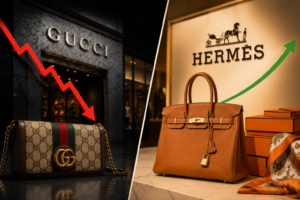
The anniversary also arrives at a moment when the luxury goods market is navigating one of its most complex periods in recent memory. Kering, which owns Gucci and Saint Laurent, reported a 6.2% drop in first-quarter revenues. Hermès, the only house that seems immune to macro headwinds, beat expectations modestly. Against this backdrop, Louis Vuitton’s parent LVMH has used the Monogram anniversary as a cultural anchor — a reminder that in fashion, the houses with genuine heritage always have somewhere to stand when the ground shifts beneath them.
For 130 years the Monogram has survived wars, recessions, the rise of streetwear and the collapse of traditional fashion seasons. The bet is that it will survive another 130.