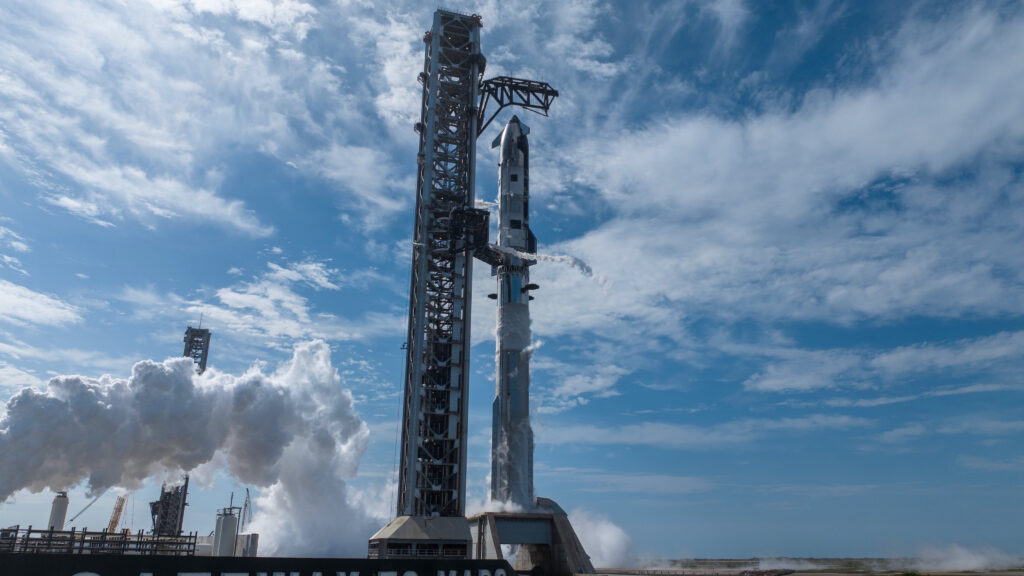
SpaceX is preparing for what could become another historic milestone in modern spaceflight after successfully fueling its next-generation Starship V3 vehicle for the first time ahead of the highly anticipated Flight 12 mission.
According to reports emerging from SpaceX’s Starbase facility in Texas, the company completed a major launch rehearsal involving the fully stacked Starship V3 system, loading more than 5,000 metric tonnes of propellant into the rocket. The successful fueling test is widely viewed as one of the final critical steps before launch clearance.
If schedules remain on track, Flight 12 could potentially launch as early as Friday, making it one of the most closely watched aerospace events of the year.
Starship V3 represents the newest and most advanced evolution of SpaceX’s ambitious fully reusable rocket system. Standing approximately 408 feet tall, the upgraded vehicle is now officially the tallest rocket ever built, surpassing earlier Starship versions by roughly four feet.
The scale of the rocket highlights the enormous ambitions behind the program.
Unlike earlier test variants primarily focused on proving launch and landing capabilities, Starship V3 is designed with much larger long-term goals in mind, including:
- Deep space exploration
- Lunar transportation
- Mars missions
- Satellite deployment
- Space cargo logistics
- Human interplanetary travel
Industry analysts consider this version of Starship particularly important because it is the first variant expected to support future long-duration deep-space operations at a meaningful scale.
The upcoming launch also carries enormous significance for NASA and the broader Artemis moon program.
NASA previously selected Starship as one of the key human landing systems for its Artemis initiative, which aims to return astronauts to the Moon for the first time since the Apollo era. Under current timelines, Starship could potentially support lunar landing missions as early as late 2028.
That partnership has dramatically increased global attention surrounding every Starship test flight.
The program’s journey, however, has been far from smooth.
When Starship first debuted publicly in April 2023, the rocket exploded just minutes after liftoff in a dramatic test flight that instantly became one of the most viral aerospace moments in recent years. Despite the failure, SpaceX engineers described the mission as a valuable learning experience that accelerated development for future launches.
Since then, the company has rapidly improved the system through aggressive iterative engineering and repeated test campaigns.
The last two Starship flights were widely considered major successes, demonstrating substantial improvements in:
- Flight stability
- Booster separation
- Controlled descent
- Engine reliability
- Heat shield performance
- Recovery operations
Those successful missions significantly boosted confidence among both investors and government partners.
SpaceX founder Elon Musk has repeatedly described Starship as the foundation for humanity’s future as a multi-planetary civilization. The company ultimately hopes the rocket will dramatically lower the cost of space travel while enabling large-scale missions to the Moon and Mars.
Experts say Flight 12 could become one of the most technically important Starship missions yet because it may test systems directly tied to future operational missions rather than purely experimental objectives.
The launch is also expected to attract enormous public attention globally, particularly among space enthusiasts, investors, and government agencies monitoring the future of commercial aerospace dominance.
Competition in the private space industry has intensified rapidly over recent years as companies race to secure leadership in:
- Lunar logistics
- Satellite infrastructure
- Deep space transportation
- Military space capabilities
- Commercial orbital services
- Future Mars exploration
Despite the excitement, significant technical challenges still remain before Starship can achieve full operational status for crewed deep-space missions.
Regulators, engineers, and NASA officials will likely closely analyze the Flight 12 mission for:
- Structural performance
- Fuel efficiency
- Re-entry systems
- Launch reliability
- Safety metrics
- Mission endurance
If successful, the mission could mark another major step toward a future where reusable mega-rockets fundamentally reshape human access to space.
For SpaceX, NASA, and the broader aerospace industry, Starship V3 is no longer just an experimental rocket — it is increasingly becoming the centerpiece of humanity’s next era of space exploration.